Exam Season: What Really Helps in the Last Two Weeks
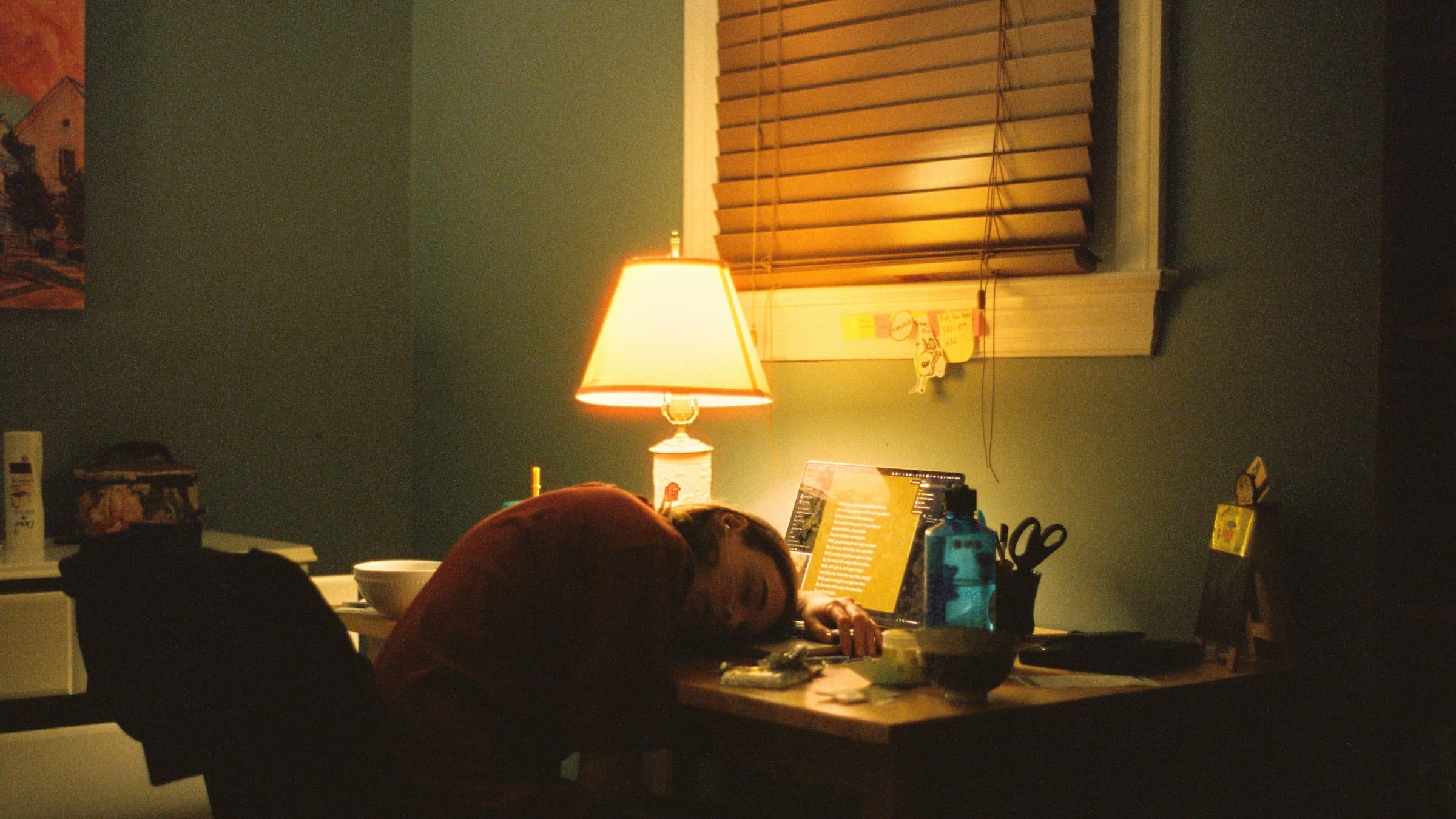
In the last two weeks before an exam, three things help most: getting enough sleep on a regular schedule, quizzing yourself instead of rereading texts, and spreading the material over several days. Exercise helps a little against tension. After an all-nighter, you perform worse the next day, and you are less likely to notice your own mistakes.
Below you will find what studies say about this, a suggested plan for the last 14 days, and signs that test anxiety is a reason to get support.
Why is sleep more important than one more night of studying?
Because sleep consolidates what you learned, and because sleep loss makes you worse at noticing mistakes.
A meta-analysis by Berres and Erdfelder of 271 samples shows that people who sleep after learning remember more later than after the same amount of time awake. The effect is moderate. If unpublished studies are included, it shrinks to small but clear.
Even a single short night with two to six hours of sleep measurably worsens sustained attention, according to a meta-analysis of 44 studies. If you skip a whole night of sleep before learning, you remember much less afterward, according to another meta-analysis. Sleeping too little also hurts retention, in a third review to a similar degree as a sleepless night.
The tricky part: after too little sleep, people are worse at noticing their own mistakes, according to a review of 28 studies. Most people then rate their own performance rather cautiously. So you do feel tired. You still catch fewer of your mistakes.
How well you sleep over a longer period is linked to your grades, though only weakly. In a meta-analysis with more than 10,000 medical students, students with better sleep quality had slightly better grades on average. That shows an association, not proof.
For the last two weeks, this means: keep regular sleep times, even when the material is piling up.
Which study techniques are worth it?
Quizzing yourself and spreading the material over several days. Highlighting and rereading help much less.
A meta-analysis by Donoghue and Hattie re-examined ten common study techniques across 242 studies. Two thirds of the participants were students. Spaced practice and practice tests helped most. Highlighting, summarizing, and rereading also helped, but much less.
| Study technique | Benefit according to Donoghue and Hattie (2021) | What to do instead or in addition |
|---|---|---|
| Quizzing yourself (old exams, flashcards) | High | Daily, also for material you feel "sure" about |
| Spaced practice | High | Review each topic on several days |
| Rereading | Medium | Read, then close the book and explain it from memory |
| Highlighting | Medium | Write questions in the margin and answer them later |
| Summarizing | Medium | Write a summary, then quiz yourself from it |
The benefit of quizzing is well supported, also outside the lab. A meta-analysis of 222 studies in real classes found a moderate advantage, about as large at universities as at schools. Compared with simply reviewing, the lead was smaller but clearly there.
With spacing, what matters is less the perfect interval than spacing at all. A meta-analysis by Latimier and colleagues found a large advantage for quizzing yourself on different days instead of several times in a row. Whether the intervals grew or stayed the same made no measurable difference.
Does exercise help with studying?
A little, mainly against tension. It is not a miracle cure.
A review of 30 meta-analyses with more than 18,000 people found a small to moderate benefit for thinking performance after a single workout, most clearly for attention. A meta-analysis with adolescents and young adults shows that a single session of endurance exercise slightly lowers anxiety in the moment. Calmer forms of exercise such as yoga worked somewhat better. So a walk between two study blocks is not wasted time, but it replaces neither sleep nor good studying.
A suggested plan for the last 14 days of exam season
First get an overview and quiz yourself, then close the gaps, and at the end learn nothing new.
The plan is a suggestion, based on the studies above. Adapt it to your exam.
| Period | Focus | In practice |
|---|---|---|
| Days 14 to 8 | Overview and first round of quizzing | Split the material into topics, quiz yourself once per topic, note the gaps |
| Days 7 to 3 | Close gaps, review | Quiz yourself on each topic at least twice, one to two days apart |
| Days 2 to 1 | An old exam under exam conditions | Only review, nothing new, go to bed early |
| Exam day | Arrive calmly | Eat a normal breakfast, sort out your route and materials the evening before |
Every day: regular sleep times, breaks with some movement, and study blocks with a clear task instead of "studying until evening."
When test anxiety is a reason to get support
When the anxiety keeps you from studying, costs you sleep for weeks, or makes you avoid exams.
Test anxiety is common. In the health report of Freie Universität Berlin, 26.4% of the students surveyed said they had needed counseling for test anxiety in the past twelve months. Only a small share of them actually sought counseling. The most common reason across all topics: no time.
Get support if you notice any of these in yourself:
- You cannot get yourself to study even though you have time, because the anxiety is too strong.
- You have been sleeping badly for weeks, or you get a racing heart or nausea when you think about the exam.
- You have already postponed or skipped exams because you could not bear it.
The psychological counseling centers at universities and Studierendenwerke (the student services organizations at German universities) help for free. Many offer workshops or groups on test anxiety, for example the University of Duisburg-Essen, each for their own students. The FernUniversität in Hagen offers its students free counseling on test anxiety and procrastination. Ask at your university about a similar program. How to find the counseling at your Studierendenwerk is explained in the article Psychosocial counseling at the Studierendenwerk.
If you have to wait there and need someone to talk to before your exam, psychological counseling at Studifit is one option, by video, and depending on availability also in the evening. Studifit is not psychotherapy, is not covered by health insurance, and does not make diagnoses. If your anxiety shapes your everyday life beyond exam season, please keep looking for a therapist at the same time. You will find our prices on the pricing page.
When you can't go on
If you are thinking about suicide during exam season or feel very bad, call the TelefonSeelsorge (a free crisis line, 24/7, in German): 0800 111 0 111. If your life is in danger, call 112. With an Attest (doctor's note), an exam can usually be postponed and taken later.
Sources
- Berres, S. and Erdfelder, E. (2021): The sleep benefit in episodic memory: An integrative review and a meta-analysis. Psychological Bulletin
- Wüst, L. N. et al. (2024): Impact of one night of sleep restriction on sleepiness and cognitive function. Sleep Medicine Reviews
- Newbury, C. R. et al. (2021): Sleep deprivation and memory: Meta-analytic reviews of studies on sleep deprivation before and after learning. Psychological Bulletin
- Crowley, R. et al. (2024): A systematic and meta-analytic review of the impact of sleep restriction on memory formation. Neuroscience & Biobehavioral Reviews
- Boardman, J. M. et al. (2021): The impact of sleep loss on performance monitoring and error-monitoring. Sleep Medicine Reviews
- Seoane, H. A. et al. (2020): Sleep disruption in medicine students and its relationship with impaired academic performance. Sleep Medicine Reviews
- Donoghue, G. M. and Hattie, J. A. C. (2021): A Meta-Analysis of Ten Learning Techniques. Frontiers in Education
- Yang, C. et al. (2021): Testing (quizzing) boosts classroom learning: A systematic and meta-analytic review. Psychological Bulletin
- Latimier, A. et al. (2021): A Meta-Analytic Review of the Benefit of Spacing out Retrieval Practice Episodes on Retention. Educational Psychology Review
- Chang, Y. K. et al. (2025): Effects of acute exercise on cognitive function: A meta-review of 30 systematic reviews with meta-analyses. Psychological Bulletin
- Tian, J. et al. (2024): Comparative Efficacy of Acute Exercise Intervention on Anxiety in Adolescents and Young Adults. Scandinavian Journal of Medicine & Science in Sports
- Freie Universität Berlin (2025): Gesundheitsbericht, Faktenblatt Beratungsbedarf und Inanspruchnahme von Beratung (Health report, fact sheet on the need for and use of counseling, in German)
All information in this article was carefully researched, but we cannot guarantee that it is complete or up to date. Services, waiting times and legal rules can change. As of October 2026.